Exclusive £50 Cashback Voucher
Help your friends find a student home they truly love! Refer & earn £50 on each successful booking!



Student Accommodation
From vibrant student halls to private studios — discover verified, affordable rooms near your university.
Properties
From / Month
Universities
Support

All Properties Verified
No hidden fees
Free 24/7 booking support
Flexible Payment Options
£50 Exclusive Voucher Included

Student Accommodation (1)
Private Let (2)
Young or Working Professional Housing (42)
Homestays (4)


Map View

 Filters

Map

Our student housing experts know cartagena inside out. Get free, personalised advice — no pressure.
Map View
...
With its subtropical Mediterranean climate, Cartagena is sunny almost every day of the year with an average annual temperature of 20°C. You will get to enjoy the amazing beaches, the coves, and the sandbanks. Another thing you’ll get to enjoy is the delicious food, the famous “tapas”, and finish with an “asiático”, the typical coffee of Cartagena.
The city is also home to Universidad Politécnica de Cartagena, which offers a mix of modernity and tradition that gives the university an innovative and dynamic essence. It has developed alliances with over 178 European universities since its foundation and is continuously making an effort to satisfy foreign students’ needs in order to make their stay in the region a positive experience.
Casita’s accommodation options are within walking distance to the university.
More than 4 bus stops surround the campus; Bus Stop L10 is just a 5-minute walk away.
Augusteum is just a 5-minute walk away; the Historical Military Museum of Cartagena is an 8-minute walk away.
Cartagena is a good city to live in, as it's quite a well-balanced city. It's a city full of history and industry. There's little traffic so you can use a car, you've got various hospitals and shopping centres, good links to the region's capital, Murcia, by train and bus, and San Javier airport is approximately 20km away. The city also has both mountains and beaches.
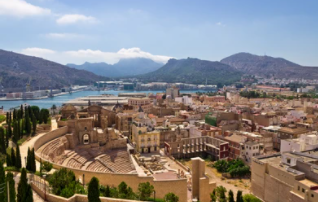
With one of the world’s great natural harbours and rich mineral mines, Cartagena has been a prized location for millennia. The Carthaginians played a big role in its evolution as an ancient trading hub in the 3rd century BC before it was conquered by the Romans. Of all the marvellous Roman landmarks in Cartagena, the 2,000-year-old theatre should be your first to see. It was discovered as recently as 1988 beneath the ruins of the Old Cathedral, which had been destroyed during shelling in the Spanish Civil War. About two-thirds of the theatre’s building material was still on-site, which made possible the very detailed restoration you can see now.
ARQUA, Marine Archaeology Museum is set in one of the western Mediterranean’s great ancient harbours, where new finds are made almost every year. ARQUA is a national centre for marine archaeology; a place where you can see remarkable historical artefacts from underwater sites, but also a research facility for experts and scholars in the field.
Another amazing place is Palacio Consistoria. One of Cartagena’s most impressive modernist wonders, the 100-year-old town hall on Plaza del Ayuntamiento was a response to the mining boom in the late-19th century, as Cartagena had outgrown its former town hall. If you get a closer look, you’ll even be able to see a few bullet holes from the Civil War.
Furthest north of Cartagena’s ancient sites you will find a late-Roman necropolis, which was set on the shore of an ancient lagoon that has since disappeared. The Municipal Archaeology Museum set there is an enthralling site, because it contains some of the latest evidence of Roman settlement, dating from 300 to 700 AD, a time of transition to Christianity. The museum has plenty of items excavated from this site, but has also gathered a wealth of artefacts from around Cartagena.
Cartagena is very small in size, you will be able to get anywhere you would like to go on foot. However, buses are also available for when you want to hop on one. Municipal buses are subcontracted to ALSA.