


British vs Australian vs American English: A Full Guide
Tips and Advice
Exploring
9 mins read


Share

Updated at: 01 November, 2026

By Samir Badawy
Tips and Advice
Exploring
9 mins read
Updated at: 01 November, 2026
By Samir Badawy
Share
British, American and Australian English are three widely recognised varieties of English. They share the same linguistic roots but differ in pronunciation, spelling, vocabulary and slang. Although speakers can generally understand one another, some expressions and accent features can cause confusion.
British English is not an unchanged original form of the language. English has evolved over centuries, and each variety has developed its own conventions through migration, cultural contact and changes in everyday speech.
In this guide, we explore the history of British, American and Australian English, their most recognisable slang expressions, pronunciation and spelling differences, and interesting facts about the language.
History of English
English belongs to the West Germanic branch of the Indo-European language family. It shares historical roots with languages such as Dutch, German and Frisian. Over time, English became an important international language, used in education, business, diplomacy and communication across cultures.
English is spoken in countries including the United Kingdom, the United States, Australia, Canada, Ireland and New Zealand. It also has official or widely recognised roles in countries across Africa, Asia, the Caribbean and the Pacific. Its global reach reflects centuries of migration, trade, colonisation, education and cultural exchange.
British English
English began developing in Britain with the arrival and settlement of Germanic-speaking communities, including the Angles, Saxons and Jutes, from around the fifth century. Their languages contributed to what is now known as Old English. The name England is linked to the Angles, one of these groups.
Before and during this period, Britain was home to Celtic-speaking communities. Celtic languages survived and continue to be spoken in parts of Britain and Ireland, although they did not simply disappear when Germanic languages arrived.
Old English was very different from modern English. One of its best-known literary works is Beowulf, an epic poem preserved in a manuscript from around the year 1000, although the poem itself is generally considered older.
Middle English developed after the Norman Conquest of 1066. French became influential in government, law, administration and elite culture, introducing many words into English. Latin also continued to influence the language through religion, education and scholarship.
Middle English is generally associated with the period from around 1150 to 1500. During this time, English grammar, vocabulary and spelling changed considerably. Written standards gradually developed, including the Chancery Standard used in administrative documents during the fifteenth century.
Early Modern English emerged around the late fifteenth and sixteenth centuries. William Shakespeare became one of its best-known writers, contributing to the popularity and recorded use of many words and expressions. However, it is difficult to establish exactly how many words he invented, since some words credited to him may have existed in spoken language before they appeared in his works.
Modern English continued to develop through the expansion of British trade and empire, the Industrial Revolution, scientific discoveries, immigration and contact with other languages. British English today includes numerous regional accents and vocabulary differences, rather than one uniform way of speaking.
American English
American English developed from varieties of English brought to North America by settlers. It gradually developed distinctive pronunciation, spelling and vocabulary as communities grew and came into contact with Indigenous languages, immigrant languages and other cultural influences.
There is no single date when American English separated from British English. The differences developed gradually over several centuries. Some spelling conventions became more standardised in the United States through the work of American lexicographers, including Noah Webster, whose dictionaries helped establish many American spellings.
American English also retains words that are less common in modern British usage. For example, fall is widely used in the United States for the season also called autumn in Britain. American English has also developed vocabulary for local plants, animals, places and cultural practices, including the word groundhog.
During the nineteenth century, wider access to education, newspapers and literature helped spread American English conventions. Writers such as Mark Twain and Edgar Allan Poe also contributed to American literary traditions.
Today, American English includes many regional varieties. Commonly recognised groups include Southern, New England, New York City and Midwestern English. Their accents and vocabulary differ, and each region contains further variation.
Australian English
Australian English began developing after British colonisation in 1788. Early settlers came from different parts of England, Ireland and Scotland, bringing their own accents and vocabulary. Their speech patterns mixed and changed over time, contributing to the development of a distinctive Australian variety.
Australian English was also influenced by Aboriginal and Torres Strait Islander languages, particularly in place names and words associated with local plants, animals and culture. Later migration, international media and contact with other English varieties introduced further changes.
Australian English is often described through three traditional accent categories:
Broad Australian: A more pronounced Australian accent, often associated with recognisable informal speech patterns.
General Australian: The most widespread variety in contemporary Australia.
Cultivated Australian: A variety historically associated with pronunciation closer to certain British accents.
These categories describe a spectrum of pronunciation rather than three fixed regional dialects. Research indicates that Australian speakers have generally shifted towards General Australian over recent decades.
Although Australian English shares many spelling conventions and historical features with British English, it has developed its own vocabulary, expressions and pronunciation patterns.
British English Slang
British slang reflects regional speech, social groups, popular culture and influences from other communities. Some expressions are widely recognised across the UK, while others are more local or informal.
Here are some common British English slang words and phrases:
Expression | Meaning |
Alright? | An informal greeting, often meaning "How are you?" or "Are you okay?" |
Bloke | An informal word for a man |
Lad | A boy or young man, depending on context |
Innit | An informal form of "isn't it?", also used as a conversational tag |
Quid | Informal term for a British pound |
Dodgy | Suspicious, unreliable or potentially dishonest |
Bevvy | An alcoholic drink, often a beer |
A cuppa | A cup of tea, or sometimes another hot drink |
Bloody | An informal intensifier used to add emphasis, sometimes expressing annoyance |
Fiver | A five-pound note or an amount of five pounds |
Tenner | A ten-pound note or an amount of ten pounds |
Proper | An informal intensifier meaning "very" or "really" in some contexts |
The meaning of slang depends on context. For example, "alright?" can be a casual greeting rather than a serious question about someone's wellbeing. Similarly, "proper" can mean "genuine" or "correct" in standard usage, as well as acting as an intensifier in informal speech.
The word "innit" is associated with several British urban speech communities and has roots in wider patterns of informal English. It became more familiar to many people through popular culture, but it was not simply invented by a fictional character.
Australian English Slang
Australian slang is well known for shortened words, informal expressions and playful language. Some expressions are widely used, while others are more regional, generational or context-specific.
Here are some common Australian slang words:
Expression | Meaning |
Arvo | Afternoon |
Bail | To leave or withdraw from a situation or plans |
Bathers | A swimsuit |
Billy | A container used to boil water, traditionally over an outdoor fire |
Bogan | An informal term for someone perceived as unsophisticated, often derogatory |
Brekky | Breakfast |
Biccy | Biscuit |
Reckon | To think, believe or consider something likely |
Straya | A colloquial pronunciation of Australia |
Barbie | Barbecue |
Devo | Devastated or very disappointed |
Defo | Definitely |
Rellie or relo | A relative or family member |
Mate | A friend or familiar form of address |
Australian English often shortens words, sometimes adding endings such as "-ie" or "-y". Examples include "brekky" for breakfast and "biccy" for biscuit. These forms are informal and may not be suitable for formal writing.
Some expressions also have specific cultural associations. "Bogan", for example, can be used humorously, but it may sound insulting depending on the speaker, audience and situation.
Australian and British slang overlap in several areas. Both varieties use "mate", and both can use "bloody" as an intensifier. However, the frequency and tone of an expression may differ between communities.
American English Slang
American English slang is widely encountered internationally through films, television, music, social media and other forms of popular culture. Many American expressions are understood in Australia and the UK, although their meanings and popularity can vary.
Some common American English expressions include:
Expression | Meaning |
Awesome | Excellent, impressive or very good |
Cool | Good, fashionable or acceptable |
Sure | Yes, certainly or an expression of agreement, depending on tone |
Beat | To defeat someone or win against them |
Whatever | An expression of indifference, dismissal or acceptance, depending on context |
In | Fashionable or popular |
Hang out | To spend time relaxing or socialising with someone |
Drop by or drop in | To visit someone, often informally and sometimes without a planned appointment |
Some of these expressions are now common in other English varieties too. For example, "cool" and "hang out" are widely understood in Australia and the UK, so they should not be treated as exclusively American.
American slang also varies by region, age group and social context. As with British and Australian English, the most useful expressions to learn are those you encounter in everyday conversation.
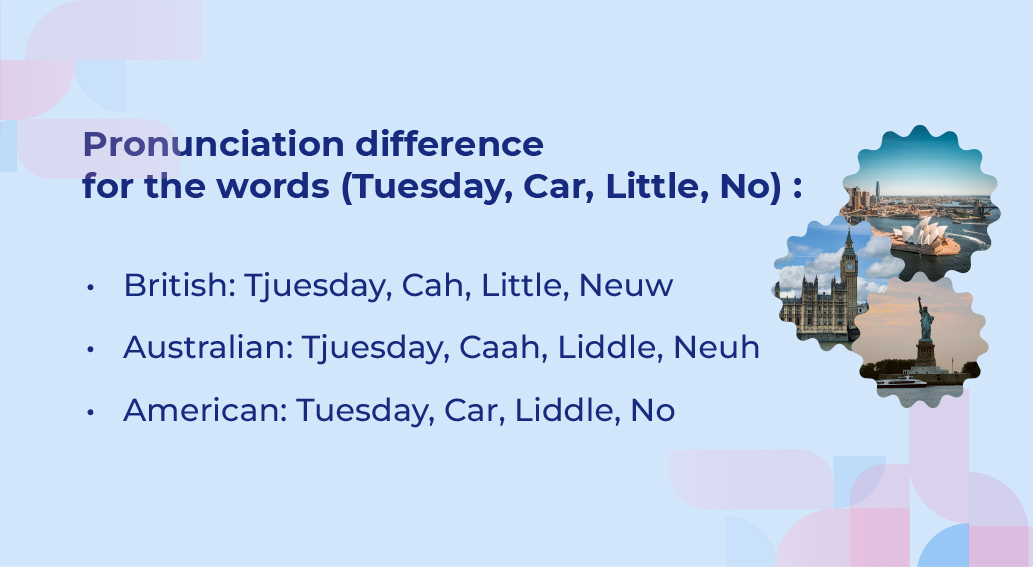
Pronunciation Differences
British, Australian and American English differ in their accents, but no country has just one way of pronouncing English. Regional, social and individual differences mean that pronunciation examples should be treated as general tendencies, not universal rules.
Some useful differences to recognise include the following.
The Letter R
Many British and Australian accents are non-rhotic. This means the R at the end of a word such as "car" is generally not pronounced when it is not followed by a vowel. Many American accents are rhotic, so the R is usually pronounced.
However, not all British accents are non-rhotic, and American English also has regional variation.
Vowel Sounds
Vowels can sound different across all three varieties. Australian speakers may pronounce vowels in words such as "day", "mate" and "price" differently from many British and American speakers. The differences are often easier to recognise by listening to complete words than by trying to represent the sounds through informal spellings.
The pronunciation of "sorry" also varies. Some American accents use a vowel that sounds different from the vowels commonly heard in Australian and many British accents. The difference is not simply that Americans replace every O sound with an A sound.
The Letter T
The T sound can change depending on its position in a word and the speaker's accent.
In some American accents, the T in "better" is pronounced as a quick sound similar to a D. This is known as a flap. Similar pronunciation can occur in some Australian speech patterns. Other speakers pronounce the T more clearly.
It is inaccurate to say that Australian and British speakers generally replace T with D, or that the T in words such as "YouTube" is universally pronounced as "Tj".
Word Endings and Intonation
The vowel sounds and pitch patterns in words such as "no", "go" and "hello" can differ between Australian, British and American speakers. However, there is no single ending sound that applies to every speaker in any of these varieties.
If you are learning English for study or work, listening to speakers from the country where you plan to live can help you recognise these patterns. Interviews, university videos, podcasts and everyday conversations are useful sources of listening practice.
Spelling Differences
Australian English generally follows British spelling conventions, while American English uses several different spelling patterns. However, Australian English has its own conventions and exceptions, so it should not always be treated as identical to British English.
Here are some common examples:
Australian and British English | American English |
Organise | Organize |
Analyse | Analyze |
Colour | Color |
Favour | Favor |
Centre | Center |
Theatre | Theater |
Travelling | Traveling |
Favourite | Favorite |
S or Z?
Australian and British English commonly use "-ise" endings in words such as "organise" and "realise". American English commonly uses "-ize" in these words.
However, spelling conventions vary by word and style guide. Australian English can also use Z in certain words, and official names should retain their established spelling.
OUR or OR?
Australian and British English use "our" in words such as "colour" and "favour", while American English usually uses "or", as in "color" and "favor".
Double L or Single L?
Australian and British English commonly double the L when adding certain endings to words such as "travel", producing "travelling". American English generally uses "traveling".
These are useful general patterns, but always follow the spelling conventions required by your university, employer or publication. In Australia, the Australian Government Style Manual recommends using an Australian English dictionary consistently.
Fun Facts About English
English has a long history, and its development includes many interesting details. Here are some facts that help explain how the language evolved.
English is a Germanic language. Although English contains many words borrowed from French and Latin, its core historical roots are Germanic.
Old English was very different from modern English. A reader today would struggle to understand much of Old English without studying its vocabulary and grammar.
French had a major influence on English after 1066. The Norman Conquest introduced extensive French influence into government, law, administration and everyday vocabulary.
English has around 1.35 billion speakers worldwide, according to one widely cited estimate. This figure includes people who speak English as a first or additional language. Totals vary according to how proficiency and speaker numbers are counted.
Samuel Johnson's Dictionary was published in 1755. It was an influential English dictionary, but it was not the first dictionary of English. Earlier dictionaries and word lists already existed.
Australian English has its own dictionaries and style conventions. The Macquarie Dictionary is a major reference for Australian English, reflecting local vocabulary and spelling.
The word "flutterby" is not the established original word for butterfly. Although it is sometimes repeated as a fun language fact, the historical development of "butterfly" does not support presenting "flutterby" as its original form.
English spelling is not completely uniform. Australian, British and American English share many words but differ in some standard spellings. Even within one variety, dictionaries can record accepted alternatives.
The history of English shows that languages are constantly changing. New expressions emerge, words acquire new meanings, and established spellings can vary between countries.
Why Learn Different Varieties of English?
English is an important language for international communication, education and business. Understanding its different varieties can make conversations easier and help you interpret unfamiliar vocabulary, accents and spelling conventions.
For international students, the most useful approach is to become familiar with the English used in the country where they plan to study. Learning common local expressions and listening to different speakers can build confidence in everyday situations.
At Casita, students can explore accommodation options in destinations including Australia, the UK and the USA as they plan their studies abroad. Understanding local language differences is one more way to prepare for life in a new country.
Tips and Advice
Exploring
By Samir Badawy
Share
Tips and Advice
Exploring
Updated at:
By Samir Badawy
Share


