




Best Cities in Germany for International Students in 2026
5 mins read


Share

Updated at: 16 September, 2026

By Nora Mostafa
5 mins read
Updated at: 16 September, 2026
By Nora Mostafa
Share
When international students decide to study abroad, they usually start by choosing the country and then the city. Selecting the right city is an important decision because it will shape your academic experience, lifestyle, and career opportunities.
The student must choose a city based on the best universities, student life, cost of living, and the political environment. This raises an important question: why do international students choose German cities for their studies?
This guide will provide you with information to help you identify the best student cities in Germany and discuss the biggest comparison: Munich vs Berlin for students and other comparisons.
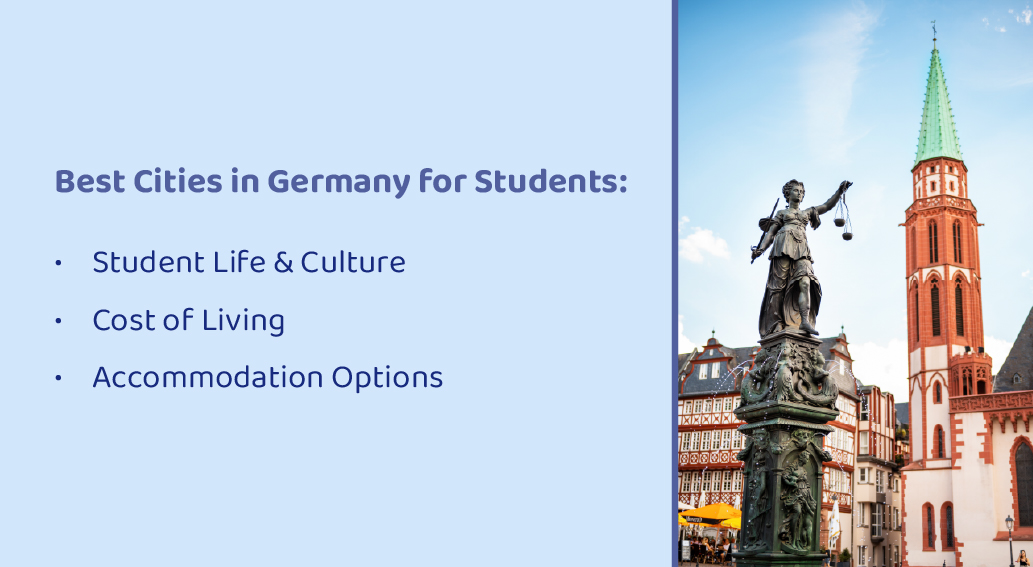
Top Cities in Germany for International Students
Berlin
Berlin ranks seventh among the best student cities in Germany according to the QS Best Student Cities 2026. As Germany's capital, it is recognised as one of Europe's leading student destinations. This reputation stems from its combination of high-quality education, affordability, a vibrant cultural scene, and part-time job opportunities.
Best Universities in Berlin
Berlin hosts world-class institutions offering programmes in business, technology, the arts, and the sciences. It is home to three universities that are recognised in the QS World University Rankings: Free University of Berlin, Humboldt University of Berlin, and the Technical University of Berlin.
If you find learning the German language to be quite challenging, don’t worry. Most German universities offer courses in both English and German, allowing international students to study comfortably. You can choose from many programmes available at various universities.
Student Life and Culture
Student life in Berlin is vibrant and diverse, with over 200,000 students benefiting from tuition-free public universities. The city is generally safe for students, but it is noisier and busier than other cities like Freudenberg and Bacharach.
There is no shortage of activities in Berlin; the city offers too many cultural events and boasts a legendary nightlife. You can visit landmarks such as the Brandenburg Gate, the Reichstag, the East Side Gallery, and the Berliner Fernsehturm.
Accommodation
Berlin is an affordable city compared to other European cities, making it easy for students to find cost-effective accommodations. Casita offers various affordable options available, many of which are conveniently located near university campuses and the city centre. Here are some accommodation options:
Cost of Living
Berlin offers a high standard of living at lower costs compared to most other German cities. The overall cost of living, which includes rent, food, and transportation, provides good value for money.
The city has an extensive public transport system, making it easy to commute between different areas at a low cost. Here’s the cost of Living in Berlin, according to Nembeo:
Category | Cost |
Meal at an Inexpensive Restaurant | €13 - €18 |
Cappuccino (Regular Size) | €3.50 - €4.50 |
Soft Drink | €2.50 - €3.50 |
Milk (1 litre) | €0.90 - €1.30 |
One-Way Ticket (Local Transport) | €3 - €5 |
Monthly Public Transport Pass | €55 - €70 |
Munich
Munich is considered one of the best student cities in Germany, ranking fourth globally according to QS Best Student Cities 2026. The city is home to 20 universities and higher education institutions. Additionally, Munich is known for being one of the safest cities in Germany, with a well-organised public transport system.
There are many student-friendly activities to enjoy in Munich, such as visiting the English Garden, exploring the Deutsches Museum, and experiencing the lively atmosphere of Oktoberfest. The city also has countless cafes, parks, and cultural events to keep students connected to the city.
Best Universities in Munich
TUM University is a national leader in engineering and technology, while LMU is renowned for its science and humanities programmes. They offer English-taught programmes to attract more non-German speakers.
Student Life and Culture
Munich has a vibrant student culture that incorporates modern technology, making it an appealing destination for international students in a safe environment. Cultural partnerships provide discounted access to museums and theatres. Compared to Berlin, Munich is less chaotic and places a strong emphasis on career networking.
Accommodation
The demand for accommodation in Munich is particularly high at the beginning of the semesters. However, you can quickly check Casita options to secure your accommodation hassle-free. These include:
Cost of living
According to Numbeo, the cost of living in Munich is slightly higher than in Berlin. We can observe the following price differences:
Category | Cost |
Meal at an Inexpensive Restaurant | €16 - €20 |
Cappuccino (Regular Size) | €3.50 - €4.50 |
Soft Drink | €2.50 - €3.50 |
Milk 1 Litre | €1.00 - €1.30 |
One-Way Ticket (Local Transport) | €3.50 - €4.50 |
Munich VS Berlin
Munich vs Berlin for students is a comparison most students are searching for. According to Numbeo:
The overall cost of living, including rent, in Munich is 11.6% higher than in Berlin.
Rent prices in Munich are 17.1% higher than those in Berlin.
Grocery prices in Munich are 2.0% higher than in Berlin.
Hamburg
If the previous cities didn’t attract you and you are still thinking about where to study in Germany, we still have more answers. Hamburg, the second-largest city and one of the best student cities in Germany, is the answer.
Studying in Hamburg offers a high-quality experience that is both vibrant and green, blending maritime charm with a dynamic, modern atmosphere. While Hamburg can be somewhat expensive, students benefit from a rich cultural scene, excellent public transportation, and top-tier academic institutions.
Best Universities in Hamburg
Hamburg is home to a dozen universities, according to Hamburg.com. Approximately 10,700 international students and researchers reside in the city. If you are interested in pursuing a degree in business, science, law, or the arts, Hamburg offers more than 500 study programmes, ensuring there is a major suitable for everyone.
Studying in Hamburg provides access to various scholarships, such as merit scholarships for international students.
There are 18 top universities, according to Edurank, such as:
Hamburg University of Technology (TUHH)
University of the Federal Armed Forces Hamburg
Student Life and Culture
Hamburg is an excellent place to find part-time work. It has become easier for students to balance work and study commitments. Whether you arrived in Hamburg with a scholarship or personal savings, taking on a part-time job is a great way to earn extra money and enhance your experience.
Recently, the German government increased the work hours for international students, allowing you to work up to 140 full days or 280 half days each year.
Accommodation
Since Casita has properties all over the world, let’s provide you with some options for different budgets.
Downtown Premium+
Cost of Living
Hamburg is one of the more expensive cities in Germany, but students can still manage their budgets effectively. Let’s view the price list from Numbeo:
Category | Cost |
Meal at an Inexpensive Restaurant | €13 - €18 |
Cappuccino (Regular Size) | €3.75 - €4.75 |
Soft Drink | €2.50 - €3.50 |
Milk (1 litre) | 1.10 € |
One-Way Ticket (Local Transport) | €3.50 - €4.50 |
Monthly Public Transport Pass | €50 - €65 |
Which German City Is Right For You?
Choosing the right city is just as important as choosing the right degree. If you prefer the hyper energy in Berlin, the high-tech corporate landscape of Munich, or the maritime charm of Hamburg, you will always find what you are looking for in one of Germany's cities.
These cities offer higher education, a welcoming international community, and a unique entry into German culture and the European job market. For more information about studying in Germany, you can read the student Experience: Studying in Germany.
By Nora Mostafa
Share
Updated at:
By Nora Mostafa
Share


