


Studying in Valencia: A Complete Student Guide
7 mins read


Share

Updated at: 09 November, 2026

By Nour Shehata
7 mins read
Updated at: 09 November, 2026
By Nour Shehata
Share
Valencia is Spain's third-largest city. It has two public universities, a cost of living lower than Madrid and Barcelona, and a climate that averages over 300 sunny days per year. These factors have made it a popular choice for international students, particularly those seeking an alternative to Spain's larger capitals.
This guide covers what you need to know if you're considering studying in Valencia: the universities, the admission process, costs, accommodation options, transport, and daily life.
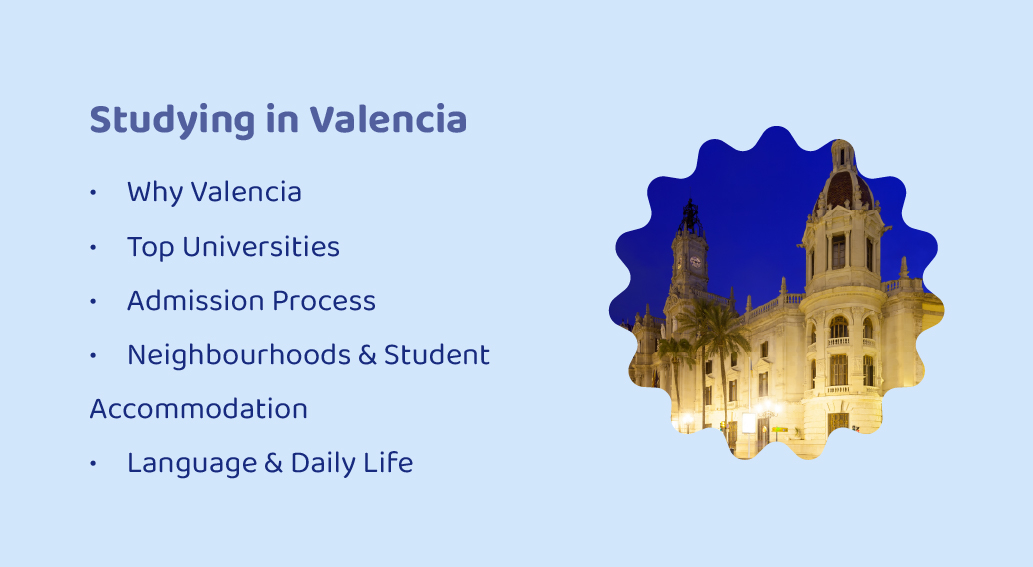
Why Study in Valencia as an International Student?
Valencia is becoming an increasingly popular destination for international students in Spain thanks to its strong universities, lower living costs, and high quality of life compared with cities like Madrid and Barcelona.
Well-respected Universities
Institutions such as the University of Valencia and the Polytechnic University of Valencia attract thousands of international and Erasmus students each year and offer a wide range of programs.
Lower Cost of Living
Valencia is noticeably more affordable than Madrid or Barcelona, with shared student accommodation costing €300-€500 per month.
Compact and Student-friendly City
Most areas are well connected by metro, tram, and bike lanes, making it easy for students to reach universities and city centres within 20-30 minutes.
Large International Student Community
A strong Erasmus presence and international population make it easier for new students to meet people and adapt quickly.
Top Universities in Valencia
Students interested in studying in Valencia will find two major public universities in the city. Each has its own personality, strengths, and campus culture. Understanding the difference between them is your first step toward choosing the right fit.
University of Valencia (UV)
The Universitat de València is one of Spain's oldest and most prestigious academic institutions. Founded in 1499, it has nearly 525 years of history. It’s a good choice for international students thanks to its extensive networks of Erasmus and international exchange agreements.
Today, the UV is a comprehensive university with:
- 60,000 students.
- Campi spread across Valencia: Blasco Ibáñez, Burjassot, and Tarongers.
- Particular excellence in: Medicine, law, social sciences, humanities, and natural sciences.
Language
Most undergraduate programs are taught in Spanish (Valencian is used in some departments). Still, the university offers a growing number of master's programs entirely in English, particularly in economics, business, and European studies.
Polytechnic University of Valencia (UPV)
Universitat Politècnica de València is the technical powerhouse of the region. Founded in 1968 and attaining full university status in 1971, it has rapidly built a reputation as Spain's premier technical university.
Today, the UPV has:
- 30,000 students.
- Often ranked among the top engineering universities in Spain.
- Five campuses, with the main Vera campus in northern Valencia functioning as a mini-city of faculties, research centres, and student housing.
- International recognition: Frequently appears in global subject rankings for engineering, computer science, and architecture.
Language
Most undergraduate programs in UVP are taught in Spanish. The university offers more English-taught bachelor's degrees than most Spanish technical universities, particularly in engineering. At the master's level, English-taught programs are common. The campus has bilingual signage and English-friendly administrative support.
Other Institutions
While UV and UPV dominate, Valencia has smaller players worth mentioning:
- Cardenal Herrera University (UCH): A private university with programs in health sciences, veterinary medicine, and communications. Smaller classes, more personalised attention, higher tuition.
- Valencia International University (VIU): An online university based in Valencia, offering flexible distance learning options.
- Berkeley Study Abroad Centre: UC Berkeley has a permanent study centre in Valencia, bringing top American students to the city each year.
Which One Fits You?
- For medicine, law, humanities, or pure sciences: University of Valencia.
- For engineering, architecture, computer science, or design: Polytechnic University of Valencia.
- For a traditional city university experience: UV's campuses are integrated into different neighbourhoods.
- For a modern campus with everything on site: UPV's Vera campus is self-contained.
Both are public universities, which means:
- The regional government sets tuition.
- Fees for non-EU students are higher than for EU students, but still below UK/US levels.
- Degrees are recognised across Europe.
Admission Process for International Students
Navigating the Spanish universities' admission system can seem daunting, but understanding the process will make your application journey much smoother.
The UNEDasiss System
All international students must validate their qualifications through UNEDasiss, Spain's official credential evaluation service. The scoring system awards a maximum of 10 points based on your high school grades, with an additional 4 points available through the PCE UNED exams (Pruebas de Competencias Específicas).
Required Exams
- Non-EU students: Must take 4 subjects in the PCE UNED exams.
- EU students: Need 2 additional subjects to improve their admission scores.
Exams are offered twice yearly, the regular session in late May/early June and an extraordinary session in early September.
Step-by-Step Admission Process:
- Validate your high school diploma (homologation process)
- Get official translations of all documents through consular services
- Register for PCE UNED exams and select your subjects strategically
- Submit your university application via the UNEDasiss platform
- Apply for a student visa if you're from outside the EU/EEA
It’s advised that you start this process at least 6-8 months before your intended start date to allow time for document processing and visa appointments.
Best Neighbourhoods in Valencia for Students
Benimaclet
Benimaclet is the undisputed favourite among students. This vibrant neighbourhood sits close to both universities, offers affordable rent (€250-350 per room), and has a youthful atmosphere with plenty of cafes and restaurants catering to student budgets.
Ruzafa
Ruzafa attracts those seeking a trendier, multicultural vibe. While slightly pricier (€300-400 per room), this former working-class neighbourhood has transformed into Valencia's hippest area, packed with international restaurants, vintage shops, and weekend markets.
El Pla del Real
El Pla del Real offers a more upscale option near the universities. It's extremely safe, well-maintained, and popular with both students and young professionals, though rent runs slightly higher.
Algirós
Algirós provides a quieter, family-orientated environment while remaining well-connected to both campuses. It's perfect for students who prefer a calmer atmosphere without sacrificing convenience.
Camins al Grau
Camins al Grau is ideal if you're studying at UPV or want to live near the City of Arts and Sciences. This modern neighbourhood offers good value and easy access to the beach.
Best Student Accommodation Options in Valencia
- Galileo Flats Central Market: offers furnished student apartments in central Valencia, close to the Central Market and key city landmarks. It’s a 15-minute ride from the University of Valencia.
- Galileo Galilei: a student accommodation located on the campus of the Polytechnic University of Valencia, close to several universities and well connected to the city. 24 mins by public transport to Central Valencia
- Micampus Burjassot Parque - 25 mins by public transport to Central Valencia
- Galileo Flats Congress Palace - 27 mins by public transport to Central Valencia
- Micampus Burjassot - 27 mins by public transport to Central Valencia
Cost of Living in Valencia
One of the biggest advantages of studying in Valencia is its affordability compared to other major European cities. Here's what you can expect to spend as a student in 2026, according to Numbeo:
| Expense Category | Monthly Cost (€) |
| 1-bedroom apartment (outside city centre) | 700 - 1,150 |
| 1-bedroom apartment (city centre) | 900 - 1,500 |
| Restaurant meal (inexpensive) | 10 - 20 |
| Transport (youth monthly pass) | 14.90 |
| Utilities (electricity, water, gas) | 107 - 170 |
| Estimated monthly costs (without rent) | €706.2 |
Budget-Friendly Tips:
- Shop at Mercado Central for fresh, affordable produce
- Take advantage of the youth transport pass (under 31 years old)
- Cook at home; Spanish groceries are incredibly affordable
- Look for "menú del día" lunch specials at local restaurants (€10-15 for three courses)
Note: These are estimates for 2026. Always check current prices before your move.
Getting Around Valencia
Valencia's integrated transport system makes getting around the city easy and affordable for students.
SUMA/Móbilis Card
One card covers everything: metro, tram, and buses. Simply load it up and tap as you go.
| Mode | Details | Cost |
| Metro & Tram | Connects Valencia to suburbs and airport; runs 6:30 AM - 11:30 PM | €20-30/month (youth pass) |
| EMT Buses | Comprehensive city coverage; real-time arrivals via app | Included in the monthly pass |
| Valenbisi | Public bike-sharing system, perfect for short trips | €30/year |
| Walking | Valencia is flat and pedestrian-friendly | Free |
Student Discount Alert: If you're under 31, you qualify for the youth monthly pass at just €20 for unlimited travel across the entire integrated network; that's up to 50% off regular fares.
The metro connects directly to the airport, making arrivals and departures stress-free. Most students find they can get anywhere they need within 30 minutes by public transport.
Language and Daily Life
What Languages Will You Need?
Daily life in Valencia operates primarily in Spanish (Castilian). While you'll also hear Valencian (a variant of Catalan), especially from older generations in certain neighbourhoods, it's not essential for students. English is common in tourist areas and universities, but don't expect it to carry you through everyday interactions at the market, in government offices, or with landlords.
Recommended proficiency: A2/B1 level for basic daily tasks; B2 for most university programs.
Adapting to Spanish Time
Get ready to adjust your internal clock:
- Lunch: 2-3 PM (the main meal of the day).
- Dinner: 9-11 PM (yes, really!).
- Esmorzaret: A late breakfast tradition around 10-11 AM featuring hearty sandwiches with pickles.
Working While Studying in Valencia
Your student visa allows up to 30 hours per week of work, enough to supplement your budget without overwhelming your studies.
High-demand sectors for student workers:
- Tourism and hospitality (hotels, restaurants, tour services)
- Language teaching (English, Arabic, and other languages are in demand)
- Logistics and delivery services (especially during peak seasons)
- University support roles (library assistants, tutoring, research assistance)
Many students find part-time work through university job boards, local Facebook groups, or student employment platforms. Hospitality jobs are particularly abundant during the summer when tourism peaks.
Make the Move
Valencia won't suit everyone. If you need the prestige of Madrid or the cosmopolitan energy of Barcelona, those cities exist for a reason. But if you want a serious university education, a manageable cost of living, and a city that's genuinely pleasant to live in day to day, Valencia makes a strong case for itself.
The paperwork is real and the process takes time, so start early. But once you're through it, you're in a city where the sun is out most of the year, the food is good and cheap, and the student community is large enough that you won't struggle to find your people.
Both UV and UPV have the academic credentials to take you where you want to go. The neighbourhoods are walkable, the transport is affordable, and the pace of life is one most students end up genuinely enjoying rather than just tolerating.
It's a practical choice that doesn't feel like a compromise. That combination is harder to find than it sounds.
By Nour Shehata
Share
Updated at:
By Nour Shehata
Share
