




Top Universities in the UK and How to Find Yours?
University Life
7 mins read


Share

Updated at: 22 November, 2026

By Nora Mostafa
University Life
7 mins read
Updated at: 22 November, 2026
By Nora Mostafa
Share
Choosing a university is one of the most important decisions for students planning to study in the UK. With hundreds of universities offering different courses, teaching approaches and student experiences, finding the right one can take time. University rankings are a useful starting point, but they are not the only factor worth considering. Some universities perform particularly well in specific subjects, while others offer course structures, locations and student support services that better match individual needs.
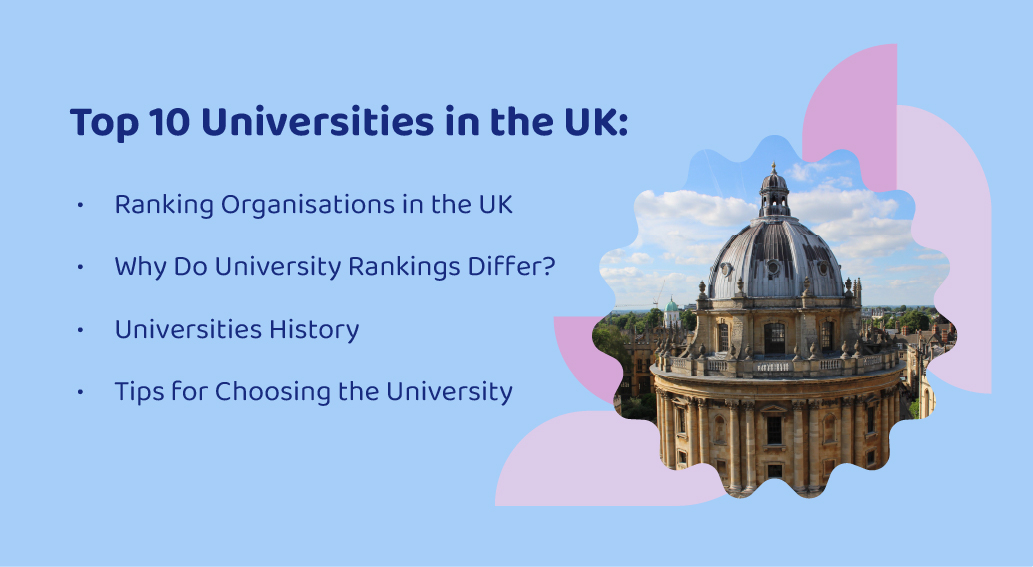
Top University Ranking Organisations in the UK
When researching universities, students will come across several ranking organisations. Each uses different criteria to assess universities, so their results can vary. Understanding how these tables work makes it easier to compare institutions and decide which information matters most to them. Here are two important university ranking organisations to know.
Complete University Guide (CUG)
The Complete University Guide publishes annual UK university league tables. Its rankings help students compare institutions using measures related to academic performance, student experience and graduate outcomes. The Complete University Guide 2027 assesses universities using ten measures:
Entry standards
Student satisfaction
Research quality
Research intensity
Academic services spend
Facilities spend
Continuation
Student-staff ratio
Graduate prospects: outcomes
Graduate prospects: on track
Times Higher Education (THE) Rankings
Times Higher Education publishes international university rankings that assess institutions across five main areas:
Teaching
Research environment
Research quality
International outlook
Industry
The THE World University Rankings use 18 performance indicators to evaluate universities, including academic reputation, research productivity, research impact, international collaboration and industry income.
Why Do University Rankings Differ?
No single ranking system measures every aspect of university life. Some place greater importance on research, while others consider student satisfaction, graduate prospects or teaching resources.
For example, the University of Cambridge ranks first in the Complete University Guide 2027, while the University of Oxford ranks first among UK universities in the Times Higher Education World University Rankings 2027. This difference does not mean one ranking is incorrect. It reflects the different indicators and weightings used by each organisation.
Top 10 Universities in the UK According to THE 2027
1. University of Oxford
THE UK Ranking 2027: 1st | World Ranking: 1st
The University of Oxford is one of the oldest universities in the English-speaking world, with teaching dating back to at least 1096. It has a collegiate structure, with colleges providing academic and pastoral support alongside the university's departments and faculties.
Students number around 22,000 in total, just over half of whom are undergraduates, while over 40% are international students, representing 140 countries. Oxford offers undergraduate and postgraduate programmes across the humanities, social sciences, medical sciences, and mathematical, physical and life sciences.
Students can explore courses such as philosophy, politics and economics (PPE), medicine, law, engineering science, English language and literature, and computer science. Its academic environment places importance on independent learning, research and discussion. The university's tutorial system also gives students opportunities to discuss their work in small groups or individual sessions. Students can check Oxford undergraduate courses to learn more.
2. University of Cambridge
THE UK Ranking 2027: 2nd | World Ranking: 5th
The University of Cambridge is one of the world's most established higher education institutions, with a history dating back to 1209. Its collegiate structure brings together academic departments, research facilities and 31 colleges, creating a distinctive university experience.
Cambridge offers a broad selection of undergraduate courses, including mathematics, engineering, medicine, computer science, economics, law, natural sciences and modern languages. Its course structure allows students to explore their chosen subjects through academic teaching and independent study.
The university is also known for its research contributions across multiple disciplines. Students considering Cambridge should review the undergraduate courses and admission requirements for their intended programme, as these can vary by subject.
3. Imperial College London
THE UK Ranking 2027: 3rd | World Ranking: 8th
Imperial College London was founded in 1907 and is a London-based university with an academic focus on science, engineering, medicine and business. It is a relevant option for students interested in scientific research, technological development and their practical applications. The college has around 15,000 students and 8,000 staff.
The university offers a range of undergraduate and postgraduate programmes. Its academic environment brings together different disciplines, giving students opportunities to explore research and innovation in areas related to science, technology, healthcare and business. The institution boasts 14 Nobel Prize winners, including Sir Alexander Fleming, the discoverer of penicillin.
4. University College London (UCL)
THE UK Ranking 2027: 4th | World Ranking: Joint 17th
University College London was established in 1826 and is a multidisciplinary university based in central London. It offers programmes across a broad range of academic fields, including arts and humanities, education, engineering, law, life sciences, medical sciences and social sciences.
Its diverse course offering gives students the opportunity to explore different academic interests.
The student body is nearly 36,000 strong, and UCL has one of the largest postgraduate systems in the country. UCL also has an international student community and research environment, making it an option for students looking for a university with a broad global outlook.
Applicants should compare individual programmes to understand their modules, teaching methods, entry requirements and available study opportunities. Students can check the UCL undergraduate degrees.
5. University of Edinburgh
THE UK Ranking 2027: 5th | World Ranking: Joint 29th
The University of Edinburgh was founded in 1583 and is one of Scotland's oldest universities. Located in Scotland's capital, it offers undergraduate and postgraduate programmes across a wide range of disciplines. Students can explore courses in areas such as arts and humanities, business, computer science, engineering, law, medicine, science and social sciences.
The university's academic structure includes several colleges and schools, each offering different subject specialisms. Edinburgh may appeal to students who want to study in a historic city with a varied academic offering and an international student community.
6. King's College London (KCL)
THE UK Ranking 2027: 6th | World Ranking: 40th
King's College London was founded in 1829 and is a research-focused university with several campuses across central London. It offers programmes across the humanities, law, sciences, social sciences, business and health-related disciplines.
Its course options include dentistry, law, medicine, nursing, psychology, international relations, and computer science. Students interested in health and medical fields can explore the university's range of programmes and associated research areas.
King's College London is now Europe's largest centre for healthcare education, with three teaching hospitals and a student community of more than 27,000, including nearly 10,500 postgraduate students from 150 countries. The university also has established strengths in law, the humanities and social sciences.
7. London School of Economics and Political Science (LSE)
THE UK Ranking 2027: 7th | World Ranking: 47th
The London School of Economics and Political Science opened in 1895 and is a specialist university based in central London. It is particularly relevant to students interested in understanding economic, political and social issues through academic research and teaching.
LSE offers programmes in areas such as economics, accounting and finance, law, government, international relations, management, sociology and social policy. Many courses explore the relationship between institutions, societies, businesses and governments. Its location in London also gives students access to a major international centre for finance, business, public policy and cultural activities.
8. University of Manchester
THE UK Ranking 2027: 8th | World Ranking: 60th
The University of Manchester traces its origins to 1824, when the Manchester Mechanics' Institution was established. The present university was formed in 2004 through the merger of the Victoria University of Manchester and the University of Manchester Institute of Science and Technology (UMIST).
It offers undergraduate and postgraduate programmes across a wide range of academic disciplines, including engineering, business, medicine, science, humanities and social sciences.
Students can explore courses such as accounting and finance, biology, chemical engineering, computer science, economics, medicine and law. The university also has research strengths across several fields, giving students opportunities to study in an environment where academic research is central to university life.
9. University of Bristol
THE UK Ranking 2027: 9th | World Ranking: 82nd
The University of Bristol traces its origins to 1876, when University College, Bristol opened. It received its Royal Charter and became the University of Bristol in 1909. The university offers more than 600 degree programmes across a broad range of disciplines. Its 28 academic schools are organised into six faculties: Arts, Life Sciences, Science, Engineering, Social Sciences and Law, and Health Sciences.
Its undergraduate courses include subjects such as Aerospace Engineering, Economics, English, Law, Medicine, Psychology and Veterinary Science. Students can compare the available programmes to understand their academic content, assessment methods and admission requirements.
10. University of Glasgow
THE UK Ranking 2027: 10th | World Ranking: 83rd
The University of Glasgow was founded in 1451, making it one of Scotland's oldest universities. Located in Glasgow, it offers undergraduate and postgraduate programmes across the arts, humanities, business, education, engineering, medicine, science and social sciences.
Students can explore subjects such as accounting and finance, business, computing science, engineering, and law.
The university's broad academic offering lets applicants compare disciplines and identify programmes that match their interests. Its location in Glasgow also provides access to a large city with a varied cultural scene and student community.
Tips for Choosing the Best University for You
University rankings are a useful starting point, but the best choice also depends on your academic goals, budget and preferred lifestyle. Before making your decision, consider these seven factors:
1. Match Your Interests and Career Goals
Choose subjects that interest you and support your future career plans.
Consider whether you prefer practical learning, research or theoretical study.
2. Compare Course Content
Review core and optional modules.
Check course duration, teaching methods and assessment styles.
Look for placement years, internships and study-abroad opportunities.
For more guidance, read the UCAS guide to choosing a UK course.
3. Check Entry Requirements
Review the academic qualifications and grades required.
Check English language requirements for international applicants.
Confirm how the university assesses qualifications from your country.
4. Plan Your Budget
Compare international tuition fees across universities.
Research available scholarships and bursaries.
Consider differences in living costs between cities.
Choose the Right University for Your Future
Choosing the right UK university involves more than finding the highest-ranked institution. Students should consider their preferred course, entry requirements, tuition fees, location and available support before making a decision.
The universities featured in this guide offer different academic strengths and student experiences, so comparing them carefully can help narrow down the options. With thorough research and a clear idea of their priorities, you can find a university that supports both their academic ambitions and future plans.
University Life
By Nora Mostafa
Share
University Life
Updated at:
By Nora Mostafa
Share
